


Ellen Brown of Mohave Electric Cooperative Honored as Citizen of the Year by Laughlin Chamber of Commerce
**Mohave Electric Cooperative Congratulates Ellen Brown on Citizen of the Year Recognition** BULLHEAD CITY, AZ -...

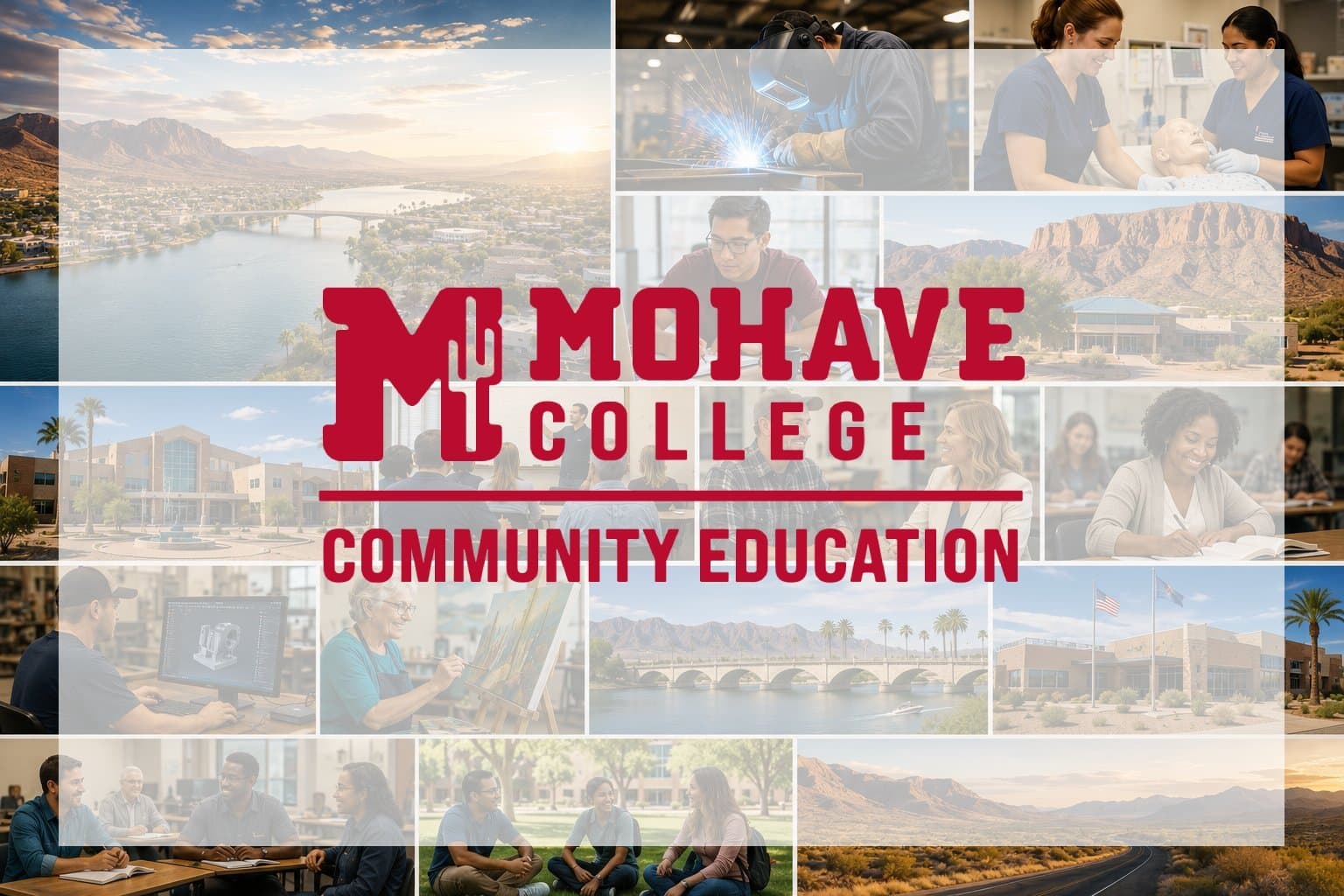
In the vast and varied landscapes of northwestern Arizona, education has never been a one-size-fits-all proposition. From the communities along the Colorado River to the high desert towns and the “strip” learning has always needed to be flexible, accessible, and deeply connected to local life.
Mohave College has grown into that role not by accident, but by design. Shaping and reshaping its community education programs over decades to reflect the changing needs, demographics, and aspirations of the people it serves.
When Mohave College first opened its doors, its offerings were modest and practical. Courses were largely occupational in nature, often held at night to accommodate working adults who needed new skills without stepping away from their livelihoods.
In those early years, education was less about academic tradition and more about opportunity. GED classes as well as programs for training welders, technicians, and skilled workers who could immediately contribute to a regional economy were the focus.
Within just a few years, however, the college began expanding its vision. Academic transfer programs were introduced in the mid-1970s. That opened pathways to university degrees. This shift marked an important turning point. Mohave College was no longer just a training ground for jobs. It was becoming a gateway to lifelong learning.
As the years passed, that dual identity would define the institution. Workforce training remained essential, but so too did persona enrichment, adult education, and hobby development programs that reached far beyond traditional degree pathways.
Few institutions are as directly shaped by geography as Mohave College. Serving a county that spans thousands of square miles and includes Kingman, Lake Havasu City, Bullhead City, and Colorado City, the college has always had to think like a network rather than a single campus.
Each community is built on its own economic evolution, cultural identity, and workforce demands. In response, Mohave College has developed a model of community education that adapts rather than standardizes.
In one region, that might mean short-term training for healthcare support roles. In another, it may involve industrial certification programs aligned with local manufacturing or trades. Elsewhere, it can look like lifelong learning classes in art, language, technology basics, or small business development. These classes are designed for residents who are not pursuing degrees but are deeply invested in personal and civic enrichment.
The result is a living system of education that evolves with its communities rather than asking communities to conform to it.
In recent years, Mohave College has refined and expanded its non-credit programming under the umbrella of Corporate and Community Education. These programs reflect a modern understanding of what education means in a rural, economically diverse region. It is not only preparation for employment, but also a tool for adaptability and for building a stronger sense of community.
Corporate education initiatives focus on workforce development. This includes leadership training, technical skills, and customized instruction for employers seeking to strengthen their teams. Community education, by contrast, leans into curiosity and personal enrichment, offering residents opportunities to explore new interests, build confidence, and remain engaged in lifelong learning. Together, they form a dual engine: one driving economic development, the other nurturing community vitality.
Adult education programs, including high school equivalency and English language study, further extend this mission. These offerings often serve as the first step back into education for individuals who left school years earlier. This creates pathways not only to employment but to building confidence and personal transformation.
One of the most distinctive aspects of Mohave College is how each campus reflects its surrounding community. Rather than duplicating identical programming across locations, the college has long recognized that Kingman, Bullhead City, Lake Havasu City, and Colorado City each require different educational emphases.
This localized approach allows programming to respond to real-world conditions. A growing retirement community in one area, hospitality demands in another, or arts classes, influence how classes are scheduled, and how they are delivered.
In many ways, each campus acts as a mirror. They reflect both the challenges and opportunities of its region.
Distance has always been both a challenge and a defining characteristic of education in Mohave County. Long before online learning became commonplace, the college experimented with telecommunications systems and video-based instruction to connect its far-flung campuses.
Today, that legacy continues through online courses and hybrid learning models that make education accessible to students who might otherwise be unable to participate due to work schedules, transportation limitations, or family responsibilities.
What began as a logistical necessity has become a strategic strength. Mohave College now serves not only local students but also working adults across neighboring states who seek flexible, affordable pathways to advancement. At its core, Mohave College’s community education philosophy rests on a simple but powerful idea. Education should belong to the people it serves.
That means more than offering classes. It means listening to employers, to retirees, to first-time students, to parents, to people changing careers. That means education is not treated as a rigid ladder, but as a network of pathways that people can enter, exit, and re-enter throughout their lives.
In a region defined by distance, diversity, and constant change, that flexibility is not just useful. It is essential.
As Mohave College moves further into the 21st century, its community education programs continue to evolve in step with economic shifts, technological change, and demographic growth. The tools may change, but the guiding principle remains steady. Meet people where they are and help them get where they want to go.
From its earliest night classes to today’s integrated workforce and lifelong learning systems, Mohave College has never stopped adapting. And in doing so, it has become something more than an institution of higher learning.
It has become a reflection of the communities it serves as well as a partner in shaping what those communities can become.
Check it out here at https://www.mohave.edu/academics/areas-of-interest/cce/community-education/
Written by Jim Hinckley’s America
**Mohave Electric Cooperative Congratulates Ellen Brown on Citizen of the Year Recognition** BULLHEAD CITY, AZ -...

FOR IMMEDIATE RELEASE November 10, 2026 City of Kingman Announces Temporary Traffic Restrictions for Lee Williams High...

FOR IMMEDIATE RELEASE November 10, 2026 Invocations at 2027 Lake Havasu City Council Regular Meetings Lake Havasu City...
0 Comments