


Mohave County Sheriffs Office Seeks Public Assistance Locating Runaway Juvenile Summer Knapp
FOR IMMEDIATE RELEASE Mohave County Sheriff's Office Deputies are seeking the public's assistance in locating a...


Times change and for more than 100 years Yucca, Arizona west of Kingman has adapted. It has endured, survived, and occasionally thrived. It is a dot on the map that is hardly noticced by people that zip past on I-40 but Yucca has a surprising history that is out of proportion to its size.
As with Kingman and several other towns in northwest Arizona and in the Mojave Desert, Yucca was established as a construction camp, order office, and water fill station for the Atlantic & Pacific Railroad in the early 1880s. From these humble beginnings a small village developed that served as a supply hub for nearby ranches, and mines in the Hualapai Mountains.
The turn of the century marked the dawn of a new era. The automobile was to be the preface for a new chapter in Yucca.
By the mid teens Yucca had evolved into an important desert oasis for pioneering motorists. Growth of a service industry was fueled by travelers on the National Old Trails Road that used the Valley Cut off through Yucca to avoid the steep grades in the Sitgreaves Pass of the Black Mountains. When Route 66 was realigned in 1952, and the Black Mountains bypassed, the new highway followed the old Valley Cutoff. This would eventually become the course for I-40
In 1942 the railroad and Route 66 figured prominently in a decision to establish a training base at Kingman. In the late spring of that year the Kingman Army Airfield was officially established. Auxiliary bases established at several locations including Site Six, now the island in Lake Havasu City, and Yucca made this one of the largest training complexes in the country.
After the war, Kingman Army Airfield was deactivated and converted into a storage depot where a vast armada of aircraft was salvaged. The Yucca base was mothballed. Then in about 1953 it was sold and repurposed as a proving gorunds for Packard automobiles. That was a short lived endeavor and in 1953, Ford Motor Company purchased the site and established the Arizona Proving Ground. In 2007 it was sold to Chrysler. Shortly afterwards Harley Davidson also moved some of its testing operations to the site, utilizing the tracks and facilities for motorcycle testing.
The types of vehicle testing conducted at the site have been comprehensive, ranging from durability and efficiency tests to high-speed track evaluations and off-road capability assessments. The first generation Ford Thunderbird was tested at the sites as were Edsels and first Ford Broncos. Four-wheel drive systems were tested here and all sizes of Ford trucks were tested at the facility as well as in real world conditions on highways in the Colorado River Valley were summer temperatures often climb past 120 degrees.
For those interested in the convergence of history and modern development, Yucca, Arizona, offers a unique narrative that is still being written. It’s a testament to the enduring spirit of the American West, a spirit that continues to inspire and drive progress in the most unexpected of places.
Written by Jim Hinckley of Jim Hinckley’s America
FOR IMMEDIATE RELEASE Mohave County Sheriff's Office Deputies are seeking the public's assistance in locating a...
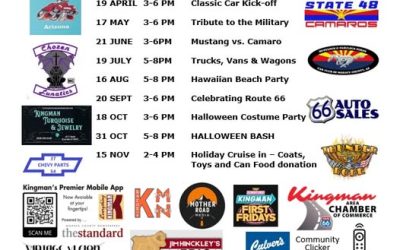
Thank you, Joyce Wiley of the Kingman Office of Tourism for this information. The first month of summer is shping up...

Mohave County Sheriff's Office Investigates Shooting Incident On Saturday, January 25, at 8:54 AM, deputies from the...
0 Comments